
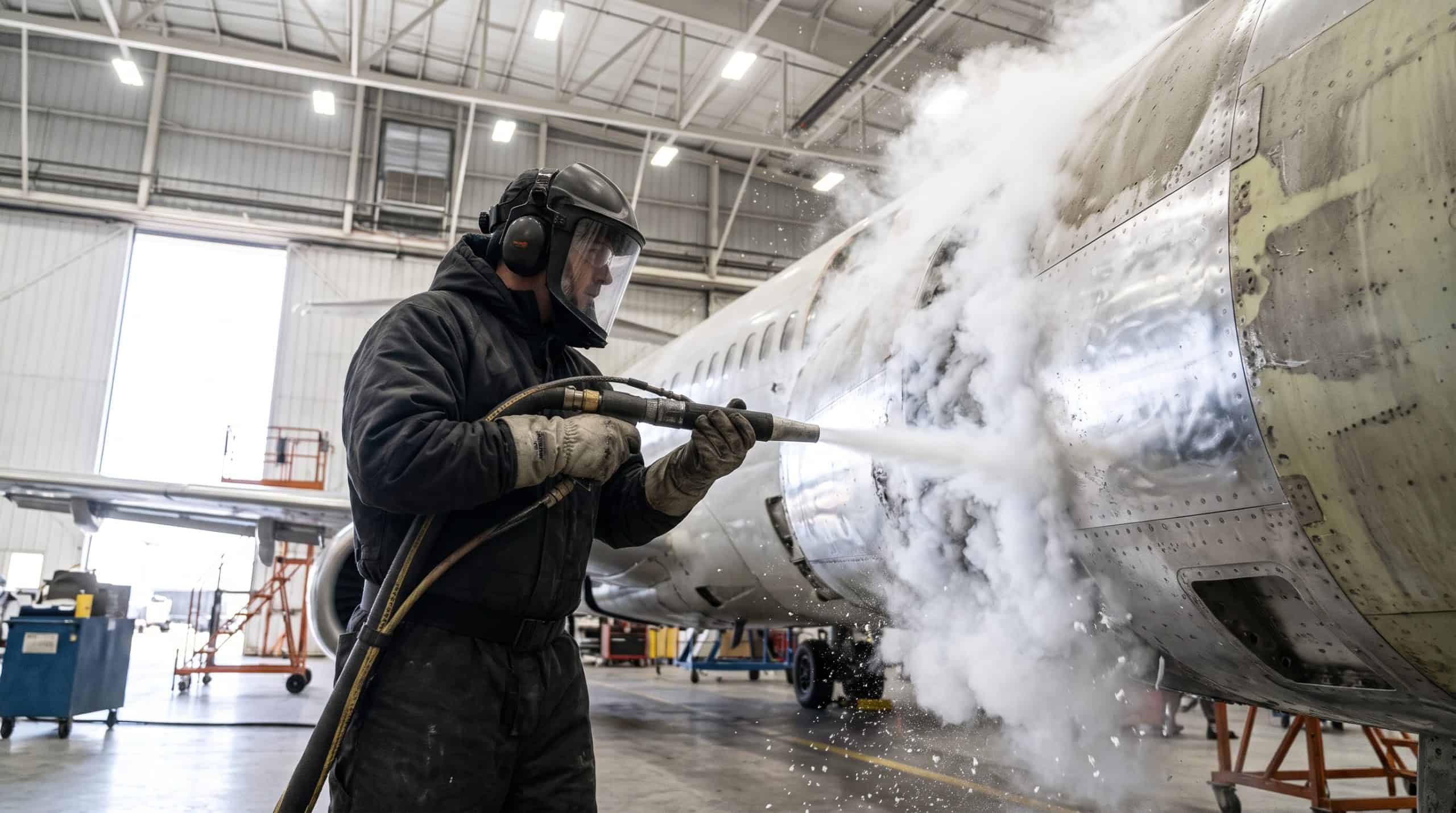
Alternatives to chemical paint strippers for aircraft include dry media blasting (plastic or starch media), laser ablation, and flashlamp-assisted CO2 pellet processes. Dry ice blasting alone is better suited to removing overspray, coatings residue, and contamination than stripping whole paint systems. Methods must be approved for the airframe’s substrate.
Alternatives Compared
Aircraft coating removal methods and what published sources report
|
Method |
How it removes coating |
Waste profile |
Substrate notes |
|---|---|---|---|
|
Chemical strippers (baseline) |
Solvent action; historically methylene chloride |
Hazardous waste and rinse water |
Not suitable for composites; improper use is a known corrosion source |
|
Plastic media blasting |
Impact of soft plastic beads |
Spent media |
Mature technology; softer media protect metal |
|
Starch dry media |
Impact of starch media |
Recyclable dry media |
Reported to strip high-solids coatings |
|
Laser ablation |
Laser vaporizes the coating layer |
Boeing reports 90%+ less hazardous waste |
Precise; used for large components and full aircraft |
|
Flashlamp plus CO2 pellets |
Pulsed lamp pyrolyzes paint; pellets remove it |
No pellet media waste |
Combined process |
|
Dry ice (CO2 pellet) blasting alone |
Impact, thermal shock, sublimation |
No media waste |
Reported ineffective for full paint systems |
Where Dry Ice Blasting Fits in Aircraft Maintenance
- Contaminants nexAir lists: carbon buildup, grease and oil, adhesive residue, polymer buildup, dust, paint and overspray, coatings, and release agents.
- Non-abrasive and moisture-free: pellets sublimate at -78.5 °C (-109.3 °F), leaving no media.
- Typical roles: cleaning engine housings, landing gear assemblies, hydraulic components, avionics enclosures, and composite tooling.
Selection Checklist
- Identify the substrate: aluminum, titanium, or composite.
- Identify the coating system and thickness.
- Use only processes approved by the OEM structural repair manual and the operator’s engineering authority.
- Run a test panel and inspect the substrate afterward.
- Plan waste handling for the chosen method.
Frequently Asked Questions
What are the main alternatives to chemical paint strippers on aircraft?
Dry media blasting with plastic or starch media, laser ablation, flashlamp-assisted processes, and non-hazardous chemical strippers. Selection depends on the substrate (aluminum or composite), coating thickness, and the OEM- and operator-approved process.
Can dry ice blasting strip aircraft paint?
nexAir lists paint overspray, coatings, and release agents among the contaminants dry ice blasting removes, but industry reporting has found CO2 pellet blasting alone ineffective for stripping complete aircraft paint systems. It is better suited to cleaning and spot coating removal, or to use alongside other processes.
Why avoid chemical strippers on composite aircraft structures?
Chemical strippers can attack the organic resin components of composite materials, such as epoxy-impregnated graphite fabric, so mechanical or other non-chemical methods are used on composites.
How much can laser ablation reduce hazardous waste?
Boeing reports that laser ablation can decrease hazardous waste by more than 90 percent compared with chemical stripping and media blasting.
Sources: nexAir aerospace (https://www.nexair.com/dry-ice/aerospace/); Products Finishing, Alternative Processes to Methylene Chloride (https://www.pfonline.com/articles/alternative-processes-to-methylene-chloride), 1990s reporting; Boeing laser paint removal (https://finishingandcoating.com/index.php/liquid-coat/1115-boeing-s-laser-paint-removal-is-safe-fast-and-environmentally-friendly); US Patent 4,836,858 (https://image-ppubs.uspto.gov/dirsearch-public/print/downloadPdf/4836858). The sublimation point is a general physical value.


