
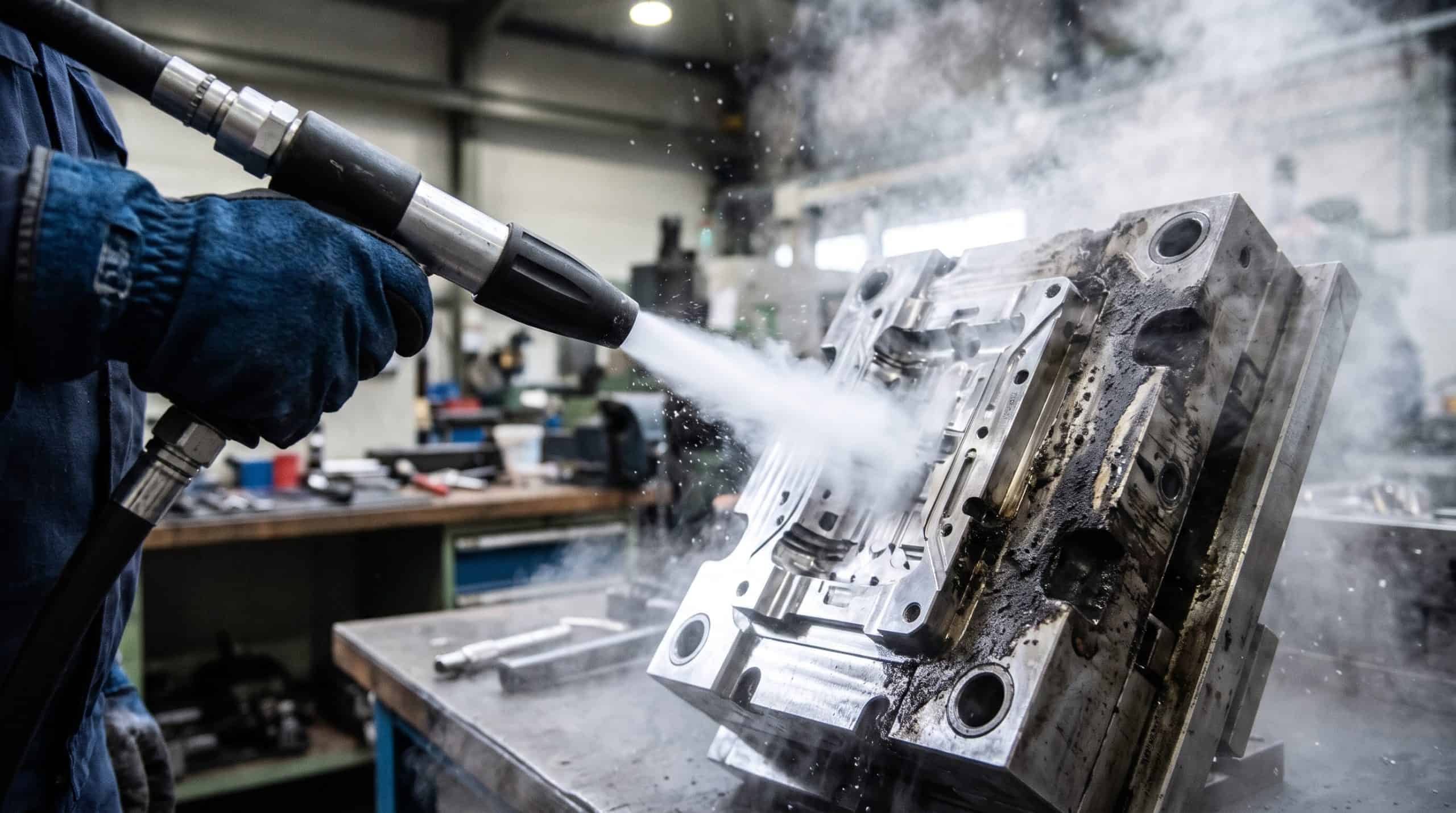
Clean precision tooling with dry ice blasting: compressed air propels solid CO2 pellets that break residue loose, then sublimate into gas instead of grinding the surface. It is a non-abrasive, chemical-free method that removes polymer buildup, release agents, and carbon without scratching steel, aluminum, or composite tooling when properly set up.
Tooling Types and Contaminants Named by nexAir
Applications listed on nexAir’s injection molding and aerospace pages
| Tooling | Contaminants removed | Outcome described |
|---|---|---|
| Injection molds (steel, aluminum, composite) | Polymer buildup, release agents, carbonized plastic, oils | Smooth cavity surfaces, consistent part release |
| Rubber molds (tire, gasket, seal) | Rubber residue, oils, polymer byproducts | Mold surface and part release preserved |
| Blow molds | Resin deposits, adhesive residue | No abrasive scraping |
| Composite and autoclave tooling | Resin buildup, release agents | No scratching or degrading of composite molds |
Surface Wear Risk by Cleaning Method
General comparison for tooling surfaces
| Method | Surface wear risk | Leftover media or residue | Disassembly |
|---|---|---|---|
| Dry ice blasting | Non-abrasive when matched to surface | None from media | Often cleaned in place |
| Sand, bead, or soda blasting | Can scratch, etch, or erode surfaces | Spent media to remove | Often needed to clear media |
| Chemical solvent cleaning | No abrasion; check solvent compatibility | Solvent residue and waste | Varies |
| Manual scraping or polishing | Scratch risk from tools | None | In place, but labor-intensive |
How the Three Mechanisms Protect the Surface
- Kinetic impact: pellets loosen buildup without grinding.
- Thermal shock: extreme cold makes residue contract and lose adhesion to the substrate.
- Sublimation expansion: pellets turn to gas at -78.5 °C (-109.3 °F) and lift residue away, leaving no media behind.
Setup Factors That Protect Finish and Tolerance
- Set pellet flow, air pressure, and nozzle selection for the tooling material and finish.
- Test a non-critical area first on highly polished or textured cavities.
- Use trained operators; technique affects results as much as equipment.
- Ventilate: sublimation releases CO2 gas, especially in enclosed spaces.
Frequently Asked Questions
Can dry ice blasting scratch precision tooling?
Dry ice blasting is widely used as a non-abrasive method when matched to the surface and contaminant. The pellets sublimate on impact instead of grinding the surface, but pressure, pellet flow, and nozzle selection still need to be set for the tooling material and finish.
What tooling materials can be cleaned with dry ice blasting?
nexAir’s mold-cleaning guidance covers steel, aluminum, and composite molds, including injection, blow, rubber, and composite tooling. Test a non-critical area first on highly polished or textured finishes.
Does precision tooling need to be disassembled before dry ice cleaning?
Often not. Molds and tooling can frequently be cleaned in place, which reduces labor, downtime, and the handling damage that can occur during teardown and reassembly.
What contaminants does dry ice blasting remove from tooling?
It removes polymer and plastic buildup, release agents, carbonized plastic, oils and grease, rubber residue, adhesives, and coatings. The pellets sublimate, so only the removed contamination remains to collect.
Source references: nexAir plastics and injection molding (https://www.nexair.com/dry-ice/injection-molding/) and nexAir aerospace (https://www.nexair.com/dry-ice/aerospace/) pages. Non-dry-ice comparison rows reflect general industry practice. The sublimation point is a general physical value.


